Review of the 2024 Azimut 80 Flybridge: Performance and Luxury
The 2024 Azimut 80 Flybridge represents a significant evolution in the Italian shipyard’s lineup, blending contemporary design with practical engineering. This model targets experienced owners seeking a balance between long-range cruising capability and onboard luxury. The vessel’s exterior, penned by Alberto Mancini, emphasizes clean lines and a sporty profile, while the interior, developed in collaboration with New York–based design firm, reflects a more residential approach to yacht living. The overall layout is intended to optimize both social spaces and private accommodations.
Under the hull, the Azimut 80 Flybridge employs a two-tier pod drive system paired with a pair of MAN V12 engines. The standard configuration offers a cruising speed in the mid-20 knot range, with a top end reaching over 30 knots under favorable conditions. The hull design incorporates a variable deadrise and a modified-V shape, which contributes to stability at rest and efficiency at planing speeds. Owners evaluating this model often consider the interplay between performance figures and fuel consumption, as well as the noise and vibration levels experienced in the interior compartments.
This review examines the key aspects of the vessel: propulsion and engine performance, handling and maneuverability, interior design and comfort, deck layout and flybridge features, and construction and engineering. The focus remains on describing how these systems function and what owners may expect under typical usage, rather than asserting definitive outcomes.
Propulsion and Engine Performance
The standard power for the Azimut 80 Flybridge consists of twin MAN V12 1,400 hp diesel engines, coupled with ZF pod drives. This arrangement allows the yacht to reach a maximum speed of approximately 32 knots and a cruising speed of 26 knots, depending on load, sea conditions, and hull cleanliness. At a more economical pace of 10 knots, the range extends to around 600 nautical miles, making it suitable for coastal passages and island hopping. The pod drives provide enhanced directional control compared to traditional shaft drives, as each pod can rotate independently, which aids in docking and tight maneuvers.
The engine room is accessed via a watertight door from the cockpit and features soundproofing insulation that reduces operational noise in the aft cabins to around 60 decibels at cruising speed, a level comparable to quieter competitors. Volumetric fuel tanks are located amidships to minimize trim changes as fuel is consumed. The air intake and exhaust systems are designed with oversized vents to maintain consistent engine breathing, which is particularly noticeable when operating at higher RPMs in warm climates. Owners may consider the optional upgrade to MAN V12 1,550 hp engines, which provides a slight increase in top speed without significantly altering fuel consumption curves, though the standard configuration is already well-suited for most itineraries.
Handling and Maneuverability
The Azimut 80 Flybridge’s handling characteristics are strongly influenced by its hull form and appendages. The modified-V hull with a 14-degree deadrise at the transom allows for a smooth transition onto plane, typically occurring around 14 knots with standard tank levels. At displacement speeds, the yacht exhibits modest roll motion, which is further dampened by the optional Seakeeper gyroscopic stabilizer. At planing speeds, the hull remains responsive to helm inputs, with a turning radius that feels predictable even in tight channels.
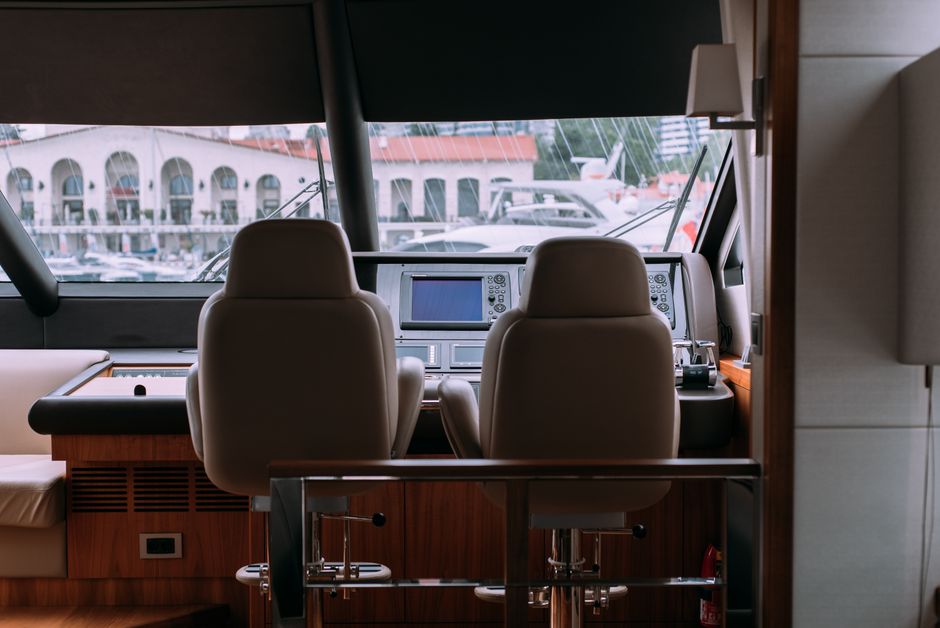
The joystick control system, integrated with the pod drives and bow thruster, enables precise maneuvering in marinas. The system allows for lateral movements and rotation around the vessel’s center. The helm station, located on the flybridge, includes dual Raymarine multifunction displays, allowing the captain to monitor current draw, engine data, and navigation. The steering system uses a hydraulic pump with electronic feedback, offering a degree of resistance that varies with speed, preventing oversteering at high speeds. In conditions with beam seas of 1.5 meters, the vessel’s tendency to bank into turns is moderate, and the keel shape helps maintain directional stability.
Interior Design and Comfort
The interior layout of the 2024 Azimut 80 Flybridge is arranged over three decks, with the main deck featuring an open-plan salon and galley. The use of light oak woodwork and neutral fabrics creates an airy atmosphere, while the large windows allow natural light to penetrate deep into the space. The galley is placed forward on the main deck, separated from the salon by a low counter, which facilitates conversation between guests and the cook. The lower deck houses four guest cabins, each with an en-suite bathroom, plus a full-beam master stateroom located amidships. The master stateroom includes a walk-in closet, a desk, and a private settee area, and the hull windows in this area are relatively large for a yacht of this size, contributing to a sense of openness.
The climate control system uses chilled-water air conditioning with individual temperature controls in each cabin, allowing occupants to adjust settings according to preference. Sound insulation between cabins consists of mineral wool and decoupled panels, which reduces transferred noise from adjacent spaces. The crew quarters, situated forward on the lower deck, include two cabins with a shared head, and are accessed via a separate stairway to maintain privacy for owners and guests. The use of non-slip flooring materials in high-traffic areas, such as the galley and companionway, is a practical consideration that owners may appreciate during extended passages.
Deck Layout and Flybridge Features
The flybridge on the Azimut 80 is designed as a secondary social hub, featuring a large U-shaped settee, a dining table for eight, and a sunpad area forward. The hardtop provides shade while allowing airflow through open side panels. The helm station is positioned to starboard, with a second control station amidships for docking assistance. The flybridge can be equipped with a wet bar, refrigerator, and grill, enabling outdoor cooking without descending to the galley. The seating is upholstered in marine-grade vinyl that resists UV fading, and the surrounding coamings are high enough to feel secure at sea.
The cockpit area, located aft on the main deck, functions as a connection point between the swim platform and the salon. It includes a fold-out transom seat, a storage locker for fenders, and a shallow wet bar. The swim platform itself is large enough to store a tender up to 3.8 meters, and the hydraulic passerelle can be used for boarding or as a support for the tender when launched. The side decks are wide enough to walk safely, with waist-high bulwarks and molded non-slip surfaces. The anchor system, housed in the forepeak, uses a vertical windlass with dual chain lockers, and the bowsprit integrates roller fenders to protect the hull during anchoring.
Construction and Engineering
The Azimut 80 Flybridge is built using a combination of hand-laid fiberglass and vacuum-infused components for the hull and superstructure. The hull is infused with vinylester resin to reduce water absorption and weight, while the deck and interior bulkheads are cored with PVC foam to maintain stiffness without adding excessive weight. The engineering systems are arranged for accessibility: the engine room has a dedicated workbench, and the plumbing runs are color-coded and labeled. The electrical system uses a 24 VDC house bank with lithium-ion batteries, charged by the engines or a 12 kW generator, and includes a battery monitoring system that displays state of charge for each bank.
The seacocks and thru-hulls are constructed from bronze, and the underwater exhausts are fitted with sound-absorbing mufflers. The fuel system includes a polishing loop with a Racor filter, which helps maintain fuel quality over time. The fresh water system uses a stainless steel tank with a capacity of 1,200 liters, and the optional watermaker can provide an additional 200 liters per hour. The structural engineering follows classification society rules (RINA and CE), and the vessel is delivered with a certification that covers hull integrity and fire safety. Overall, the construction methods employed in the 2024 Azimut 80 Flybridge reflect current industry practices, and the systems are designed with redundancy in mind, such as dual steering pumps and separate bilge pumps for each compartment.